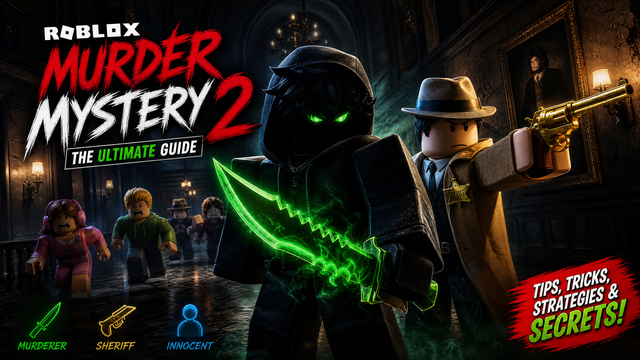
Murder Mystery 2, created by Nikilis back in 2014 as the successor to the original Murder Mystery, is one of Roblox's longest-running social deduction games, and its entire structure runs on a simple trick: every round hands out three different roles, and only one player in the whole server actually knows who's who. More than a decade in, the game has amassed over 27.6 billion visits, and it still runs across a rotation of different maps and three distinct modes: Standard, the base rule set described above, Disguises, a variant with an added twist on the core loop, and Assassin, a faster and more aggressive spin on the same three-role structure.
Innocent: survival is the whole job
Up to ten players in a round get the Innocent role, and they spawn with absolutely no weapon. That's not a disadvantage so much as the point of the role. Innocents are meant to run, hide, and pay close attention to everyone else's behavior, functioning as the Sheriff's eyes and ears rather than fighting anyone directly. Winning as an Innocent means surviving long enough for the Murderer to get caught, which makes watching other players closely just as important as staying out of sight.
Sheriff: the only real weapon on the good side, with a real cost attached
Exactly one player per round becomes the Sheriff, and they're the only person who spawns armed, carrying the sole gun capable of taking the Murderer down directly. That makes the Sheriff the single biggest threat to the Murderer's plans, but the role comes with a built-in punishment for getting it wrong: shoot an Innocent by mistake, and the gun drops immediately, free for absolutely anyone in the server to grab. A trigger-happy Sheriff can hand the Murderer's biggest threat straight to whoever's standing nearby, which is exactly why good Sheriffs wait for real evidence before firing.
Murderer: one knife, two ways to use it, and a timer working against you
The Murderer is also just one player, armed with the only knife in the round, and their job is to eliminate everyone else, Innocents and the Sheriff alike, before time runs out, all without ever getting shot. The knife isn't limited to melee range either: it can be thrown for a ranged kill, which opens up assassination angles a Murderer restricted to close combat wouldn't have, but also means a missed throw can leave them exposed and weaponless for a stretch. Every kill has to be weighed against the risk of being seen or heard doing it, since a single sighting can turn the whole server against them for the rest of the round.
The Hero role: how an Innocent can win the round outright
If the Sheriff dies, their gun stays on the ground for anyone to pick up, and any Innocent who grabs it and successfully shoots the Murderer becomes the Hero, effectively finishing the Sheriff's job for them. It's the game's built-in comeback mechanic: losing the Sheriff early doesn't automatically doom the Innocents, it just moves the responsibility for catching the Murderer onto whichever Innocent is brave enough, or lucky enough, to reach the gun first.
How a round actually ends
The win conditions are straightforward once you know the roles: Innocents and the Sheriff win the moment the Murderer is shot dead, while the Murderer wins by surviving to the end of the timer without ever taking a bullet. Every decision in a round, from a Sheriff holding fire to a Murderer choosing between a knife throw and waiting for a better opening, comes back to that one binary outcome.
Coins, boxes, and where the real economy lives
Outside of individual rounds, MM2 runs on a coin economy earned just by playing and by collecting Coin Bags scattered across the maps, which build up both coins and experience. Coins get spent on boxes that drop knives and guns across a full rarity spread, running from common all the way up to Godly and Chroma tiers. Godly weapons specifically function as the real currency of MM2's community: with 160 of them in total, split between 99 knives and 61 guns, they're what most serious trades actually revolve around, and new traders are generally better off learning which Godlys carry real demand before attempting to trade up into higher-value items.


