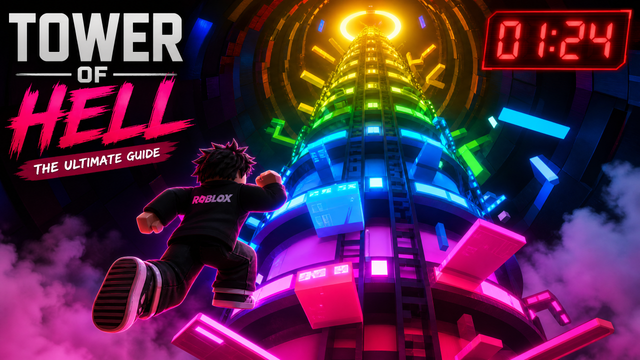
Tower of Hell, made by YXceptional Studios, is one of the simplest games on Roblox to explain and one of the hardest to actually finish: climb a tower before an eight-minute timer runs out. There's no combat, no currency, no shop, just a vertical obstacle course and a single rule that makes the whole thing far tenser than it sounds.
The rule that defines everything: there are no checkpoints
Most obby-style games save your progress as you go. Tower of Hell deliberately doesn't. Fall or die anywhere on the tower, whether you're near the bottom or one jump away from the top, and you restart the entire climb from the lobby floor. That single design choice is what makes the game genuinely tense instead of just repetitive: a mistake late in a run doesn't cost you a few seconds, it costs everything you'd already climbed.
No two towers are the same
Every round generates a fresh tower by pulling from a huge pool of pre-built segments, with community wikis documenting well over 300 distinct sections across regular, secret, and even removed content, and only a subset of those actually appears in any given round. That randomization is the reason memorizing "the tower" doesn't work the way it might in a fixed-layout obby. What experienced players do instead is learn patterns in how individual segments tend to connect and which jump types tend to cluster together, which lets them anticipate the rhythm of an upcoming stretch even without knowing the exact layout ahead of time.
The timer isn't just personal, it's shared
Each round runs on an eight-minute clock, and the twist is that the timer isn't purely about your own run. Whenever any player finishes the tower before time runs out, the remaining time for everyone still climbing speeds up. That turns Tower of Hell into something quietly competitive even though nobody is fighting anyone directly: the faster other players clear the tower, the less time you personally have left to finish yours, which punishes players who play too cautiously in a round full of fast climbers.
What actually gets harder the higher you climb
The obstacles themselves escalate in a fairly predictable direction even if their order is random: early stretches lean on straightforward jumps, while higher sections start mixing in moving platforms, blocks that vanish out from under you, and jumps that demand real precision rather than just momentum. None of these obstacle types are unbeatable on their own, but stacking several difficult segments back to back, with zero room for a checkpoint to bail you out, is what actually separates a smooth climb from a run that ends in a fall from three-quarters of the way up. Some individual sections have earned a reputation of their own among players. Ice Cave replaces solid footing with a slippery ice floor lined with killparts, which turns ordinary jumps into a fight against your own momentum. Sections built around spinners, like Double Spinner or the aptly named Maze of Spinners, add rotating hazards you have to time your jump around rather than just aim for, and stacking two or three spinner-heavy segments back to back is often where a otherwise clean run falls apart.
What you're actually playing for
Beyond just reaching the top, Tower of Hell hands out Halos, exclusive cosmetics tied to completing specific harder challenges, along with a broader set of badges tracking various achievements across the game. None of it changes how the tower plays, but it gives dedicated climbers something to chase once simply finishing a round stops being the hard part.
Why patience beats rushing
Because there's no safety net anywhere on the climb, the biggest mistake new players make is treating every stage like a speedrun from the first jump. Given that a single slip sends you all the way back down regardless of how far you'd gotten, the more reliable approach is pacing each segment deliberately, saving actual speed for stretches you've already read correctly, and only pushing hard once you can see exactly where a jump needs to land. Tower of Hell has an active speedrunning and challenge community constantly documenting tricks, optimal routes, and cosmetic strategies, and the throughline in almost all of that knowledge is the same: going fast only works once you've stopped guessing.


